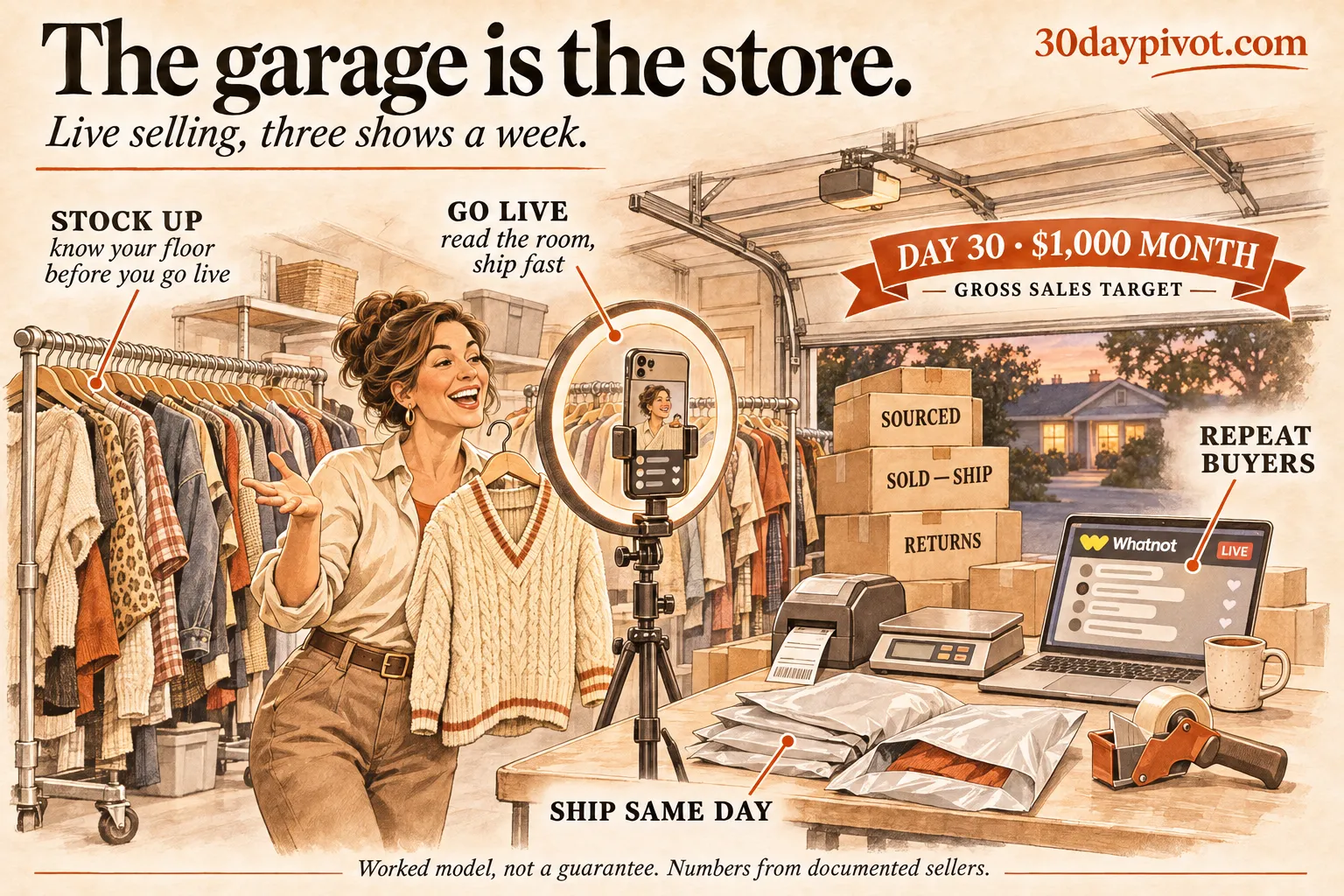
Why This Pivot: The Listing-and-Wait Problem
eBay and Poshmark sellers list clothing and wait — days or weeks — competing on photos, price, and shipping speed. Whatnot flips the model: you run live auctions where buyers see the item held up on camera, hear the measurements and flaws, and bid in short bursts. No listing backlog. No waiting. Inventory that sits for a month on a static marketplace can clear in one energetic evening.
The economics are honest about what this is: a volume-and-margin performance business. Auctions start low, items clear fast, and the money is made on the spread between a $1–$5 sourced garment and a $10–$25 hammer price — multiplied by 20–40 items a show, multiplied by a schedule your regulars can set their watch to.
Fashion is now Whatnot's #1 category by orders: 12M+ fashion orders a month, with women's fashion GMV up 223% year over year, on a platform reporting $8B+ in annual live sales. Platform-reported figures — order leadership is not the same as revenue leadership, and Whatnot doesn't publish the category revenue split.
How evidence is labeled on this page: Official Whatnot or IRS documentation, linked · Platform Whatnot's own marketing and data · Observed third-party datasets · Seller operator claims · Model this roadmap's planning assumptions. Treat each accordingly.
Flip Math: Know Your Floor Before You Go Live
US Fashion rates per Whatnot's seller-fees page Official. Whatnot changes something material every month or three — re-verify every number in this section against your Seller Hub before you rely on it.
Two fees per sale, no listing fees:
- Commission: 8% of the item's sale price (not shipping, not tax) at the Standard tier — the rate this roadmap models for Month 1. Tiered discounts are set by your total sales in fixed 28-day periods: the tier you earn in one period applies to the next period. Discounts start at $15K per period (7%) and reach the lowest published fashion rate, 4.5%, at $250K+. Ignore the tiers for Month 1.
- Processing: 2.9% + $0.30 per transaction, on the buyer's total payment — item plus buyer-paid shipping plus tax.
Shipping is paid by the buyer at Whatnot's set rates, priced by your listing's packed-weight profile (USPS Ground Advantage rates Official):
| Packed weight | Buyer pays |
|---|---|
| Under 4 oz | $4.47 |
| 4 to under 8 oz | $4.85 |
| 8 to under 12 oz | $5.25 |
| 12 to under 16 oz | $6.75 |
| 1–5 lb | $7.75 |
Multiple wins by one buyer in the same show auto-bundle into one parcel at a discounted incremental rate (Smart Bundling Official). Apparel bundles combine automatically, but apparel is not on the list of categories with automatic incremental-weight treatment — enter accurate bundle weights yourself and verify the final packed shipment before printing. Processing is still charged per transaction even when orders ship together. Free shipping comes out of your earnings: below roughly $25 it erases the margin. Don't offer it in Month 1.
The Net-Per-Item Formula
− (2.9% × (Price + BuyerShipping + Tax) + $0.30)
− COGS − Mailer
Worked table Model — one item per transaction, $3 landed cost, $0.25 mailer, $5 buyer-paid shipping (a round planning number between the $4.85 and $5.25 rate bands), buyer sales tax set to $0 for clarity (Whatnot does collect tax, which adds a few cents of processing per order). Bundled multi-item orders change the per-item math — the $0.30 and shipping spread across the bundle:
| Hammer price | Fees | Net after COGS + mailer | % kept |
|---|---|---|---|
| $1 | $0.55 | −$2.80 | — |
| $5 | $0.99 | $0.76 | 15% |
| $10 | $1.54 | $5.21 | 52% |
| $16 | $2.19 | $10.56 | 66% |
| $25 | $3.17 | $18.58 | 74% |
Hard Rules From the Table
- Break-even on a $3 garment is roughly a $4.25 hammer. Below that you're paying buyers to take your inventory.
- A $1 start is a binding contract — once an auction starts it cannot be cancelled, and every bid is final (auction rules Official). Start at $1 only on items that cost you under $1 and only once you have a room that bids. New sellers with under 20 viewers: start at $3–$5.
- The $0.30 flat fee punishes cheap items. Make $8–$10 your practical floor for single-item auctions; bundle anything below it.
With buyer-paid shipping you keep roughly 87% of the hammer price minus $0.30. Memorize that and you can price on your feet mid-show.
Set Up & Stock Up: Get Approved, Get Inventory, Get Operational
Apply on Day 1 because approval is the one timeline you don't control — the official line is that many sellers unlock access within minutes, but some applications get extra review, and seller reports run from same-day to two weeks. Everything else this week works whether or not you're approved yet. One calendar note: the day numbers are a sequence, not dates. Map show days onto your real week and move each next-day fulfillment block with them — shipping deadlines always outrank the numbering.
Apply, Then Set Your Loss Cap
- In the Whatnot app: + Sell → Get Started. Agree to guidelines, pick Fashion and your subcategory, answer the experience questions, add links to any eBay/Poshmark/Instagram selling history, enter your legal name and return address.
- Complete ID verification when prompted (government ID via Stripe/Persona) and the W-9 tax step — SSN for individuals. Without a valid TIN, 24% backup withholding applies.
- Complete Seller 101 (required before going live).
- Write your launch budget on one page: equipment cap, inventory cap, and a total loss cap — the number where you stop and reassess. Recommended: $250–$600 all-in.
- Note: ordinary clothing is not a gated category. Luxury bags and surprise sets are — skip both for 30 days.
Application submitted, ID verified, one-page budget with a written loss cap.
Scout the Competition Like a Buyer
- Open Whatnot's Fashion category at 8 PM ET. Watch three small shows (under 20 viewers) and one big one (100+) for 20 minutes each.
- For 20 items per show, log: starting price, hammer price, seconds per item, how flaws were disclosed.
- Note what the small sellers do wrong — silence, no measurements, apologizing for low bids — and what the big room does on autopilot: greeting by name, constant narration, next-show plugs.
- Pick your lane: one buyer, one style, one size range (examples: workwear/Americana, Y2K women's, plus-size contemporary, 90s band tees). "Women's clothes" is not a lane — in one observed snapshot, 2,000+ sellers were already in that room.
- Write a one-sentence show promise: "Tuesday and Sunday nights: curated [lane], sizes [range], everything measured, $3–$5 starts."
Watch where the money is thin: one third-party 21-day snapshot Observed showed 2,400+ sellers splitting Baby & Kids at an $8 average order, while Western wear, workwear, and plus-size ran far fewer sellers at equal or better prices. A partial dataset — use it for relative comparisons, then verify with your own Day 2 comps. Saturation is per-niche, not platform-wide.
A comp log of 60+ real hammer prices and a written lane + show promise.
Build Your Buy Box
- Set your max landed cost: expected hammer price × 30%. A $12 average lane means a $3.50 ceiling per piece, cleaning and travel included.
- Build a spreadsheet ledger with columns: SKU, source, cost, brand, size, condition, listed price floor, show, hammer price, fees, net. This ledger is the business — ten minutes a day maintaining it beats any paid tool in Month 1.
- From your Day 2 comp log, write a target brand list for your lane (the brands that actually hammered well, not the ones blogs say are hot).
- Write your rejection list: holes, broken zippers, odors, heavy pilling, missing buttons on structured pieces, anything you can't honestly describe on camera.
- Calculate your personal break-even using the Flip Math table and tape it to your sourcing clipboard.
Buy box (max cost, brand list, rejection list) and a working inventory ledger.
First Sourcing Run
- Pick the cheapest sourcing stop your metro actually has — both routes below are first-class plans, not a main option and a fallback.
- Bins metro: Goodwill Outlet clothing runs $1.49–$2.99/lb by region — roughly $1–$3 per garment. Wear gloves, wait for staff to signal on bin rotations, don't take items from other carts, favor light, high-value pieces (denim is heavy; silk is high value per pound).
- No-bins metro (plenty of big cities, Atlanta included): run two thrift stores mid-week (fresh stock hits floors Monday–Wednesday mornings) at $2–$6 per selected piece, and work estate-sale final days for 50–75% off. Same buy box, slightly higher per-piece cost, less sorting time — the economics still clear.
- Buy against your buy box only: 30-second check per item — collar tag, underarms/cuffs/hems, "what does this hammer for live?", pass/fail.
- Target 50–75 keepers. If your closet has sellable pieces in your lane, raid it first — $0 COGS pilots are the cheapest education available.
- Log every piece in the ledger with its cost before you sleep. Untracked inventory becomes fictional profit.
Coming home light is fine. Coming home with 40 pieces that violate your buy box is how Month 1 dies. There is always another rack.
50–75 pieces logged at or under your max landed cost.
Prep Like a Pro
- Batch-wash everything per care labels. While machines run, order supplies if you haven't: 100-pack 10x13" poly mailers (~$8–$16), shipping scale (~$20–$40), tape. A regular 8.5x11 printer prints Whatnot labels fine — thermal is a later upgrade.
- Inspect each dry piece against your rejection list. Expect to cut 10–20%; sell rejects as a rag bundle or donate back.
- Steam or lint-roll, then measure: pit-to-pit and length minimum for tops, waist/inseam/rise for bottoms. Write measurements on a masking-tape tag or hang tag.
- Weigh three representative packed samples (garment + mailer) so you know your true shipping bands: most single tees sit under 8 oz ($4.85 buyer rate); jeans and bundles hit the 1–5 lb band ($7.75).
- Assign SKU numbers, stage on a rack in the order you'll present them: open strong, group by size, save two heroes for mid-show.
40–60 show-ready pieces: cleaned, measured, weighed, SKU'd, staged.
Build the Set, Rehearse, Schedule
- Build your set: phone at chest height on a tripod ($15–$30), facing a clean wall, garment fully in frame with room to show close-ups. Light from two angles if you can — Whatnot's own guide prefers two-point diffused light over a ring light for fabric. Daylight plus one $35 light works.
- Test audio with a 2-minute recording. Quiet room plus phone mic is fine; a $20 clip-on lav is the single best cheap upgrade.
- In the app: Seller Hub → menu → Settings → Rehearsal Mode (docs Official) — practice starting auctions with demo products until the controls are muscle memory. Some new sellers don't see Rehearsal Mode until after their first live show: if it's missing, record a full mock show on your phone instead — same rack, same script, played back and critiqued.
- Create 10–15 real listings: Seller Hub → Create a Product — title with brand + size + era, honest condition notes, your weighed shipping profile. Detail converts: Whatnot reports ~91% of new buyers' first purchases come from detailed, non-generic listings Platform.
- If approved, schedule Show 1 for tomorrow evening: Seller Hub → Schedule a Show (docs) — name it after your lane ("Y2K & 90s Tops, size S–L — everything measured"), pick the most specific subcategory, upload a bright 9:16 thumbnail. A short lead is fine for your first show; from Show 2 on, schedule 48+ hours out so the listing can gather bookmarks.
- Announce it on whatever social you have: one 20-second video of your three best pieces with the date/time (both ET and PT).
Working set, rehearsal (or recorded mock show) complete, 10–15 listings live, Show 1 scheduled and announced.
Show 1 — The Zero-Expectation Show
- Stage 20–25 items. Pre-decide every starting price from your break-even sheet — never look up prices mid-show.
- Go live 5 minutes early. Open with your best item at an attention price within the first 5 minutes — "open with a banger" beats saving it for a finale nobody stays for.
- Run the intro script below. Repeat a 15-second version every 10–15 minutes for new arrivals.
- Pace: 60–120 seconds per item including measurement callouts and the auction. 15–25 items in an hour is right for show one.
- Zero viewers? Keep performing: narrate fabric, styling, the sourcing story. Active, talking streams are what gets surfaced (discoverability docs Official), and your first regulars judge the replay energy too. Expect 3–15 viewers.
- Close on time: announce the next show date twice, thank buyers by name, end the stream, then immediately pull sold items into labeled bins by buyer.
Open (2 min): "Welcome in. Tonight is [lane], sizes [range] — about [N] pieces. I show the tag, the measurements, and any flaw before every auction. Starts are prices I can stand behind, and wins bundle into one shipment. Tell me your size and I'll point you at the right rack."
Each item (60–120 sec): brand and era → pit-to-pit and length → condition, flaws named plainly → one styling line → start the auction → while it runs, answer chat or tease the next piece.
No bids: "No home for this one tonight — all good, watch this next one." Move on. Never re-run the same item at a lower start twice in a row, and never announce that the room is dead.
Close (3 min): "That's the show. Next one is [day, time ET]. Winners — labels print tomorrow, everything ships within two days. If you're new, a follow means you'll catch the next drop."
You are operational: approved (or pending with everything else done), 50+ pieces prepped, set built, first show run or fully rehearsed. A first sale is a bonus, not the bar. Success this week is a functioning process.
Show 1 log — viewers, items offered/sold, hammer prices — and sold items staged for packing.
Go Live & Learn the Room: Ship Fast, Read Receipts, Repeat
Two more shows this week at one fixed slot. The goal is not revenue — it's a clean fulfillment loop and real margin data from actual receipts. Shipping discipline this week protects you from the policies that erase margins later.
Fulfill Like Your Account Depends On It
- Web browser: Seller Hub → Shipments → Needs Label — confirm bundles per buyer, verify packed weights, print labels (pack-and-ship docs Official). Never combine separately-labeled orders into one parcel without updating the shipment in Whatnot.
- Pack: garment folded, poly mailer, label flat. Plain sturdy packaging only — no USPS Priority boxes on Ground Advantage labels.
- Get proof of shipment within 2 business days: a carrier acceptance scan at drop-off, or Whatnot's in-app shipment scanning/manifest where available. A late shipment without valid proof can make refund costs yours. This is the one deadline in this business with real teeth. USPS pickup is free if you can't make the counter.
- Message any first-time buyer a one-line thank-you with the ship confirmation.
- Update the ledger: hammer price, fees from the actual order receipts (Orders → order → receipt), net per item. Compare against the Flip Math table — your first real data beats every estimate in this roadmap.
Every order shipped with proof, ledger updated with actual fees.
Replenish Only What Worked
- Review Show 1 by item: what got bids, what stalled, which sizes the chat asked for.
- Source a replacement batch biased to what moved — same lane, winning sizes. Skip what died; one show is weak evidence, but free evidence.
- Prep same-day while it's a small batch: wash, inspect, measure, SKU, stage.
- Schedule Shows 2 and 3 now, 48+ hours ahead, in your fixed slot (e.g., Thursday + Sunday): consistency in the same slot is how the platform and your early followers learn when to find you.
- Post a 15-second preview of three new pieces on your social with both show times.
Replenished rack, two shows scheduled, preview posted.
Show 2 — Same Slot, Tighter Show
- Stage 25–30 items. Fix the single worst thing from Show 1 — lighting, dead air, pace — one thing only.
- Add 3+ Buy It Now listings alongside auctions (Create a Product → Pricing → Buy It Now, enable offers). Whatnot reports roughly 2x hourly sales among sellers running 3+ BIN items Platform — an observational, platform-wide finding, not a guaranteed doubling, but a cheap test.
- Greet every arrival by name. Ask a direct question each segment ("what size should I pull next?") — chat activity, not just viewer count, is a discovery signal.
- Optional experiment: one follower giveaway mid-show — a decent piece, not junk. You pay the giveaway label ($4.47–$7.75); there are no fees on it (giveaway rules Official). Giveaway-tagged shows pulled 1.4–2.4x median viewers in one observed dataset Observed — but track what matters: do entrants return and buy? Budget it as marketing, and cut it if four weeks of data says it buys viewers, not buyers.
- Close with the next show date and a raid if you've met a complementary seller (end-of-show: type /raid username).
Show 2 log plus a comparison line vs Show 1: viewers, sell-through, average hammer.
Read the Receipts
- Ship everything from Show 2 within the window, with proof.
- Pull your true numbers from Seller Hub → Analytics → Shows (it lags 1–2 days) and your order receipts. Build one row per show: gross, fees, COGS, supplies, net, hours worked (live + prep + pack).
- Compute your real per-item net and items-per-hour. Compare to the model: the roadmap assumed ~$12 average and 10+ sold per show — where are you?
- Flag any item that sold below your break-even floor. Those start higher next time, go BIN, or get bundled.
- Note your three best sellers' brands/styles — that's the shopping list for Day 15.
A per-show P&L with real per-item net and a corrected price floor.
Build the Outside Funnel
- Set your show listings up for discovery: specific subcategory, one primary brand tag per show, descriptive title that says format and goods ("$3 Start Y2K Tops + BIN Steals").
- Post show previews where your lane's buyers live: TikTok converts fastest for Whatnot (15–30 second "what I'm selling Thursday" clip); Instagram Stories 24–48 hours ahead with the show link.
- Spend 30 minutes in two other sellers' shows in your category as a genuine participant. No spam — be a name they recognize. Raid partnerships and buyer crossover start here.
- DM or comment-thank every buyer so far; invite them to the next show. A regular who knows your schedule outspends 50 cold browsers.
- Optional: identify one complementary seller (accessories, shoes, different era) and propose a mutual end-of-show raid.
Promo posted, one raid relationship opened, all buyers personally invited back.
Show 3 — The Repeatability Test
- Same slot, same format, same lane promise. You're training an audience to form a habit; don't redecorate weekly.
- Stage 30 items with your corrected price floors from Day 11.
- Test one variable only this show — auction mode. Standard timed auctions can extend when late bids arrive; sudden death ends at 00:01 with no extension (skull icon — auction docs Official). Sudden death moves faster but can hammer at the opening bid, so use it only on items whose start you'd genuinely accept. Log which mode clears faster at equal prices.
- Call out returning names. "Welcome back, Sarah — found the Carhartt you asked about" is retention gold and costs nothing.
- Announce your Week 3 schedule as an appointment: "Every Thursday and Sunday, 8 PM Eastern."
Show 3 log and a three-show trend line: viewers, sell-through, average hammer, net.
Week 2 Reconciliation — Continue, Adjust, or Hold
- Ship everything outstanding. Check Seller Hub → Account Health (docs Official): the standing bars are 80% on-time scan / 97% refund-free / 99% cancellation-free. At your volume, On-Time Scan should read 100%. Whatnot's enforcement targets sustained problems, not one bad day — but new accounts have no cushion, so treat the bars as hard.
- Total the week: gross, fees, COGS, net, hours. Compute $/hour. Don't flinch — single digits are normal at show three.
- Answer three questions in writing: Are items selling above your floor? Is any audience repeating? Can you source enough to continue at this pace?
- Decide: Continue (metrics flat or rising), Adjust (change lane/pricing/slot — change one thing), or Hold (sell down inventory before buying more). Buying more inventory is not a strategy when the problem is the show.
- Set Week 3's sourcing budget from actual net, not hope: reinvest most of your surplus, keep the loss cap in force.
Evidence of a workable sale: real receipts, real margins, orders shipped on time, and a deliberate decision about Week 3. A failed demand test caught in Week 2 is a cheap, useful result — do not bury it under new inventory.
Week 2 P&L and a written continue/adjust/hold decision.
Lock the Schedule & Grow the Room: Three Shows, Repeat Buyers, a Sourcing Route
Cadence moves to three shows a week at fixed slots. The work shifts from "can I run a show" to "can I feed a schedule" — a repeatable sourcing route, batch prep, and the retention habits that turn browsers into regulars.
Build the Sourcing Route
- Map a fixed weekly route you can run in one morning: bins first (cheapest), then 2–3 thrifts ranked by your actual hit rate from the ledger, estate sale finals when listed (EstateSales.net).
- Call your thrifts and ask which mornings fresh stock hits the floor; route around that. Tuesday–Thursday beats Saturday.
- Run the route buying only your Day 11 winners' profile. Target enough to keep 2–3 shows fully staged ahead at ~30 items per show.
- Price the backup channel: one wholesale source for later (a mixed secondhand lot at $2–6/piece or a returns lot at $3.50–$7/piece). Do not buy a pallet in Month 1 — one bad lot can eat the whole budget, and "pennies on the dollar" claims are how new sellers end up with $3,000 in dead stock.
- Log route results per stop: spend, keepers, cost per keeper. Keep the stops that earn their drive time.
A written weekly route with per-stop economics and 2 shows of inventory staged ahead.
Show 4 — Size-Group Selling
- Stage 30 items grouped by size, and announce the size run order at open ("S–M first half, L–XL back half") — buyers stay when they know their segment is coming.
- Pull measurements on every item without being asked. Fit confidence is the #1 conversion lever in live clothing; fit issues disclosed up front aren't misrepresentation, surprises are.
- Keep a "requests" notepad by the rack. Every "do you have…" goes on the Day 17 shopping list.
- If you're running the giveaway experiment, tie it to a follower milestone ("at 75 followers I pull the hero piece") so it feeds the room's energy.
- End on schedule, raid your partner, log the show.
Show 4 log plus a size-level demand note (which sizes bid, which sat).
Fulfill + The Request List
- Ship, get proof, ledger — the Day 8 loop, now boring. Boring is the goal.
- Source or pull from backstock every realistic item on the request list; message those buyers that it'll be in the next show. A requested item with its requester in the room usually gets you an opening bid.
- Batch-prep the next show's 30 while laundry runs — at 3–6 active minutes per garment this is 1.5–3 hours of hands-on work, which is why today's budget is bigger than a plain shipping day.
- Check aging: anything offered twice with no bids gets a decision — bundle it, BIN it cheap, or cut it. Dead stock on the rack costs show time.
All orders shipped with proof, request-list items staged, aging list handled.
Show 5 — The Slot Experiment
- Run this one in a window you haven't used yet — if your fixed slots are Thursday and Sunday evenings, test Friday or Saturday evening, or a weekday 2–5 PM ET afternoon (lower competition). In one third-party 21-day apparel snapshot Observed, roughly 40% of apparel units moved between 8 PM and midnight ET, with Sunday the strongest day and Monday the weakest. One partial dataset, not a law — which is exactly why this is a test. Keep your other slots fixed; change one variable.
- Stage your strongest 30 — prime windows have more buyers and more competing shows, so open with your best three pieces in the first ten minutes. Early concurrent viewership is a reported discovery signal.
- Pre-promote harder: preview post the night before plus a one-hour-before story.
- Log the same metrics and compare contribution per total hour (prep + live + pack), not gross, against your usual slot.
A/B slot comparison with contribution per hour for each window.
Ship + Scout One Supplier Up the Chain
- Fulfillment loop, with proof, ledgered.
- Research one volume source for Month 2 with real diligence: ask for a manifest or precise mix description, grade definitions, size distribution, defect policy, freight quote. Compute landed cost per usable garment assuming 80% yield — a "$2.36/unit" lot at 60% usable is really $4 a piece.
- Buy nothing today unless it's a small sample lot under your weekly budget.
- Watch 30 minutes of one top seller in your lane and steal one mechanic (their reset patter, their bundle pitch, their claim-board rhythm). Write it into your show notes.
One vetted supplier file with landed-cost math; one new show mechanic to test.
Show 6 — Bundles vs Singles
- Test disclosed bundles against singles tonight: 2–3 piece same-size lots, every item shown on camera, count and condition stated. (Mystery and surprise formats are heavily policy-restricted and partly gated — fully disclosed bundles only, this month and probably ever.)
- Enter accurate bundle weights yourself and verify the final packed shipment — apparel lacks the automatic incremental-weight treatment some categories get, and USPS weight-adjustment chargebacks land on you.
- Keep BIN steals rotating between auctions to catch the fixed-price buyers.
- Log bundle vs single contribution per rack-minute: bundles move slow inventory and raise order value, singles usually win on $/item for heroes.
Format comparison with real numbers; a keep/kill call on bundles for your lane.
Week 3 Gate — Earn the Fourth Show
- Ship with proof, reconcile the week: three-show totals, contribution per hour, repeat-buyer count (names appearing 2+ times in your orders).
- Audit capacity honestly: Can your route feed 4–5 shows (120–150 staged pieces/week)? Is every order shipping inside 2 days? Is your Account Health clean?
- If yes to all three, Phase 4 runs 4 shows a week. Any no means Phase 4 runs 3, and that is a fine business; thrift-only sourcing often can't feed 5 shows a week, and forcing it torches margins and sleep. Running 3 instead of 4: skip Show 8 (Day 25) and use that day as a sourcing-and-prep block — the rest of Phase 4 works unchanged.
- Lock Phase 4's calendar now and announce it in your next show and socials.
Repeatability: a sourcing route that replenishes what you sell, 2–3 fixed slots your regulars can predict, and first repeat buyers in the ledger. You now run a small system, not a series of experiments.
Week 3 P&L, capacity audit, Phase 4 calendar locked.
Run the Numbers & Scale: Four Shows, a Real P&L, an Evidence-Based Month 2
The last nine days prove the economics. Shows keep running on rhythm while you tighten pricing, audit the account, and close the month with a reconciled P&L that tells you — with receipts — whether this scales, holds, or stops.
Reprice From Evidence
- Recalculate price floors per category from three weeks of actual hammer data — your numbers now beat any guide's table.
- Raise starts on anything consistently hammering 2x+ its start; drop proven dead categories from the buy box entirely.
- Stage Show 7 with your sharpest 30–35: winners' profile, request-list items, two heroes.
- Queue this week's promo posts in one sitting (both show previews plus one behind-the-scenes sourcing clip — sourcing content tends to outperform sales content for follows).
Updated floor sheet and a staged, promoted Show 7.
Show 7 — The Regulars Show
- Run your now-standard format. Open banger, size blocks, BIN rotation, on-time close, raid.
- Work the regulars deliberately: greet returning names first, pull their requests early, give the VIP treatment publicly — early access on a hero, a shoutout. Your top buyers will carry disproportionate revenue; act like it.
- Push the follow ask at natural peaks (right after a fun bid war, not during dead air).
- Log it — you should now be comparing shows week-over-week in one glance.
Show 7 log plus repeat-buyer revenue share (what % of gross came from returning names).
Account Health Audit
- Fulfillment loop, proof same-day.
- Full health pass: Account Health Dashboard metrics green, zero unresolved buyer messages. If you're enrolled in Seller Provided Support, keep your response rate above 80% — warnings precede any commission penalty, but don't collect warnings.
- Reconcile Seller Hub → Financials → Statements against your ledger to the dollar. Find every fee you didn't model (carrier adjustments, cancellation fees) and price them in.
- Cancellation policy check: your first avoidable seller cancellation is waived; after that it's the greater of $3 or 3% of the order (cancellation docs Official). The real fix is never starting an auction on an item you haven't verified in-hand.
Clean account health, ledger reconciled to platform statements.
Show 8 — Peak-Slot Rerun
- Run your best-performing slot from the Day 18 test with your best format — this is the "do it again on purpose" show that proves Week 3 wasn't luck.
- Try the 5-minute early open: live before the scheduled time, chat warm by the hour.
- Tighten pace toward your ceiling: experienced clothing rooms run 25–40 items/hour; you should be past 20 by now without feeling rushed.
- Log, compare, note what you'd teach a new seller from this show — that note becomes your standard operating checklist.
Show 8 log plus a one-page "my show format" SOP.
Inventory Truth Day
- Physical count against the ledger: every unsold SKU located, every discrepancy resolved. Shrinkage you don't measure becomes profit you imagine.
- Age every piece: 0–2 shows offered, 3+, never run. Build a clearance block for Show 9 — aged stock converts to cash and show-energy ("everything in this rack starts at $2") better than it converts to ego.
- Draft the preliminary P&L: month-to-date gross, fees, COGS (sold items only), supplies, giveaway costs, overhead. Note inventory-at-cost still on the rack — cash you've spent that hasn't come back yet.
- Count supplies; reorder mailers/labels if under two shows of runway.
Reconciled physical inventory, clearance block built, draft P&L.
Show 9 — Clearance Plus Heroes
- Structure: open hero, clearance blocks interleaved with fresh stock (pure clearance shows read as desperation; mixed shows read as deals).
- Move the aged block at honest floors — recovering $3–4 on a dead $2 piece beats a fourth week on the rack.
- Announce Month 2's schedule as a commitment: days, times, and what's coming ("December = holiday knits + party wear" — Q4 is the heaviest stretch in live apparel; Whatnot reported $75M+ in a single Black Friday day Platform).
- Log the show; note clearance sell-through for future aging rules.
Show 9 log, aged inventory substantially cleared, Month 2 schedule announced.
Build the Month 2 Machine
- Fulfillment loop, with proof.
- Write the Month 2 sourcing plan from the route data: weekly budget (reinvest the majority of surplus while keeping COGS near 30% of expected revenue), stops ranked by cost-per-keeper, one sample-size wholesale test if Week 3's diligence passed.
- Schedule Month 2, week 1 shows now — same slots, visible on your profile before this month ends.
- Decide your one Month 2 upgrade with cash the business earned: thermal printer (~$80–130) once you're printing 30+ labels a week, a second light, or a mod for chat once you're holding 20–30 concurrents. One upgrade, not five.
Month 2 sourcing plan, shows scheduled, one funded upgrade chosen.
Show 10 — Run the Playbook
- Execute your SOP start to finish with zero experiments. This is the show that tells you what your business looks like on a normal week.
- Note your items/hour, average hammer, and sell-through against the month's best — the gap between "best show" and "standard show" is your Month 2 coaching list.
- Thank the room for month one. Live-selling audiences are loyal to people; let them see one.
- Close, raid, pack.
Show 10 log — your baseline show, documented.
The Decision Day
- Ship final orders, with proof.
- Close the books — the full P&L: gross sales, commission, processing, COGS sold, supplies, giveaways, overhead, carrier adjustments. Then the cash bridge: bank cash, pending payouts (funds release ~4 hours after confirmed delivery, then 1–2 banking days — your last shows' money is still in transit), inventory at cost, supplies on hand. The worked example in the next section shows why profit and available cash are different numbers.
- Compute the three numbers that matter: net margin %, contribution per total hour worked, and repeat-buyer revenue share.
- Apply the scaling rule: add one show only when your recent shows run a positive operating surplus, fulfillment is current, replacement inventory is affordable, and the workload is sustainable — then evaluate the added show before adding another. Positive surplus but a thin audience means hold cadence and improve the shows. Negative contribution after 10 shows means change something fundamental — lane, pricing, sourcing, presentation — or stop with your loss cap intact. Both are legitimate outcomes of a real test.
- Write the Month 2 plan on one page: cadence, revenue target (your real ASP × your real sell-through — not this roadmap's placeholders), sourcing budget, one growth bet.
You have what most new sellers never build: a reconciled P&L, a repeatable show format, a sourcing route, shipped-on-time account health, and an evidence-based Month 2 decision. Whether the number says scale or stop, you earned an answer most people only guess at.
Complete Month 1 P&L, cash/inventory snapshot, one-page Month 2 plan.
Day 30 Snapshot: The Worked Model
Model — a planning example; replace every line with your actuals. Assumptions: 10 shows, 10 sold items/show at a $12 average hammer, one item per transaction, $3 landed COGS, $0.25 mailer, $5 buyer-paid shipping per order, buyer sales tax set to $0 for clarity (real tax adds a few dollars of processing), one giveaway per show. This example lands above the $1,000 hero target on purpose — the target is the goal line, the example shows the math at a slightly better month.
| Line | Amount |
|---|---|
| Gross merchandise sales (100 × $12) | $1,200.00 |
| Commission (8%) | −$96.00 |
| Processing (2.9% × (sales + $500 shipping) + $0.30 × 100) | −$79.30 |
| COGS sold (100 × $3) | −$300.00 |
| Mailers/supplies | −$25.00 |
| Giveaways (10 × label + item) — optional; skip them and surplus rises ~$80 | −$80.00 |
| Overhead (gas, cleaning, misc.) | −$60.00 |
| Operating surplus (before owner labor and income tax) | $559.70 |
| Less starter gear (lean build) | −$150.00 |
| Month 1 result after starter equipment | $409.70 |
Adding up this roadmap's own daily time budgets gives roughly 50–70 total working hours including sourcing travel. Against the $409.70 result that is about $6–$8/hour in month one. That's the honest number — month one in this business pays in audience, systems, and data, not wages. The ramp is where the money is: the documented path runs through $2K–$4K months (months 2–3, at 3–4 shows/week) toward the $4K–$8K/month mid-tier at 3–4 weekly shows with 50–100 items each.
The Cash Bridge — Why Profit Is Not Money in the Bank
| Line | Amount |
|---|---|
| Operating surplus earned (above) | $559.70 |
| Unsold inventory still on the rack (40 pieces × $3 — cash spent, not yet recovered) | −$120.00 |
| Payouts still in transit from the final shows (release after delivery + bank days) | ≈ −$150.00 |
| Starter gear already paid | −$150.00 |
| Cash actually in the bank on Day 30 (illustrative) | ≈ $140 |
The missing money isn't gone: ~$150 lands over the following 1–2 weeks and $120 is stock for Month 2's first shows. This is why the roadmap keeps a cash buffer in the startup budget and never funds new inventory from sales that haven't reached the bank.
Month 2–3 Trajectory — Conditional, Not a Forecast
| Month 1 | Month 2 | Month 3 | |
|---|---|---|---|
| Shows | 10 | 12 | 14 |
| Sold items/show | 10 | 15 | 20 |
| Average hammer | $12 | $13 | $14 |
| Gross sales | $1,200 | $2,340 | $3,920 |
| Est. operating surplus | ~$560 | ~$1,250 | ~$2,100 |
Volume, price, and sourcing quality have to improve together for this curve. If sell-through or margin stalls, fix the show before adding shows.
What's Selling Right Now: The Clothing Cheat Sheet
Demand signals are platform-reported or third-party-observed and labeled per row; re-verify before you buy heavy. Price signals are directional hammer ranges, not platform statistics — Whatnot publishes no per-category transaction data. Max buy applies the roadmap's 30%-of-hammer rule to the low end of each band: pay less than that until your own comps prove more. Brand alone never justifies the buy — garment type, era, condition, size, and your audience set the real number.
| Lane | Price signal | Max buy | Competition | The read |
|---|---|---|---|---|
| Americana / workwear (Carhartt, Dickies) | $20–$75 | ~$6 | Low-Med Observed | Best demand-to-competition balance for new sellers |
| Plus-size contemporary & vintage | $10–$60 | ~$3 | Low Observed | +590% search growth Platform; structurally undersupplied — but observed average orders ran ~$9.51 Observed, so read the band's top end as curated exceptions, not the typical ticket |
| Vintage denim (Levi's, USA-made) | $25–$100 | ~$7.50 | Medium | Durable demand; heavy to ship — weigh honestly |
| Y2K / "McBling" | $15–$45 | ~$4.50 | Medium | Searches +160% (rhinestones, low-rise, tracksuits) Platform |
| Western wear | $19–$58 | ~$5.50 | Low-Med Observed | +100% search growth Platform; few sellers |
| 90s minimalism (CK, Helmut Lang) | $30–$100 | ~$9 | Low | Lightly stocked, fashion-forward buyers |
| Vintage band/graphic tees | $25–$80+ | ~$7.50 | High | Real money, crowded rooms — needs sharp curation |
| Women's contemporary (mall brands) | $5–$16 | ~$1.50 | Very high Observed | 2,000+ sellers in one snapshot; buyers are often other resellers — avoid as a lane |
| Fast fashion / unbranded | $3–$8 | ~$1 | Saturated | Clears fees only barely; the margin is too thin for the labor. Skip. |
Formats: single-item auctions with calculated starts are your default; 3+ BIN listings per show (~2x hourly sales among sellers who do, platform-reported — observational, not causal); fully disclosed same-size bundles for mid-grade stock. Mystery and surprise formats are policy-restricted, partly gated, and closed to new applications in some categories — off the table.
Seasonality: Q4 is the giant (Whatnot reported $75M+ in a single Black Friday day Platform); stock knits, outerwear, party pieces from late October. January is reportedly soft — plan Q1 around activewear, basics, and sourcing ahead while competitors nap.
The Operators: What the Documented Sellers Actually Did
All figures are gross sales and seller-reported unless noted. None of these is a typical beginner: every documented winner arrived with some head start — sales skills, an existing business, or an audience. Copy the launch mechanics, not the numbers.
| Seller | The record | The lesson |
|---|---|---|
| Zoreen Kabani / ZKStyles Seller via CNBC and ELLE; PR-assisted |
Ex-finance; started June 2022 with ~50 thrifted pieces; $12K first month; Mon–Fri streaming from launch (per the ELLE interview); $100K/month within 16 months; up to 2,000 units shipped/week at scale, by then sourcing from liquidators | Consistency compounds — and an early-era result is not a current baseline. Treat the launch mechanics, not the revenue, as the model |
| Trash Pandas Thrift Seller — their video |
$9,153 / 1,078 items / 12 shows in month one ($459 first show); ~$30.9K first 90 days — arriving with an established resale business and an Instagram audience | The ceiling for a prepared start; their Fri/Sun/Mon fixed slots and Instagram pre-promotion are copyable even if their head start isn't |
| commonthreads (Amanda Anderson) Seller — podcast interview |
Former boutique owner and experienced reseller; ~6 months in: one show/week, $1,500–$2,000 per show, bins-sourced at $1–2/item, 3–4 hrs to ship 50–100 packages. The episode title's "$26K month" is ambiguous — possibly cumulative | A documented smaller-schedule operation, not a typical-beginner benchmark: one excellent weekly show beats five mediocre ones |
| Jamie & Sarah / junglefinds Seller — their video |
$5,000 pallet at ~$10/piece; clothing hammered ~$9 average before fees, with stock left unsold | The cautionary tale: COGS near or above your expected hammer price means the format can't pay — the buy box is the business |
Common thread across the documented winners: fixed schedule, measured-and-disclosed items, personality-forward shows, and sourcing costs well under hammer. Common thread in the failure stories: paying retail-ish prices and hoping the room bids it back.
Common Mistakes — and How to Fix Them
| Mistake | What happens | The fix |
|---|---|---|
| $1 starts on $5–$10 COGS items | Binding sale below cost — every bid is final | Start near your calculated floor; $1 starts only on sub-$1 COGS |
| Free shipping on cheap items | A $16 item keeps 54% instead of 86% | Buyer-paid shipping + bundling, always in Month 1 |
| Label printed, parcel on the counter at home | No proof of shipment = refund liability on late delivery | Carrier scan or in-app shipment proof within 2 business days, every order |
| Buying at 50–70% of expected hammer | Fees + supplies eat the rest; you worked for free | Max landed cost = 30% of expected hammer |
| Four-hour shows in week one | Burnout by Day 20 — and in one observed dataset the first 15 minutes outsold minutes 105–120 by ~3x anyway Observed | 60–90 minutes, ramp with your audience |
| Generic listings ("cute top!!") | Detail converts — ~91% of new buyers' first purchases come off detailed listings Platform | Brand, size, measurements, flaws, every item |
| Cancelling a disappointing auction | Fee of $3 or 3% (first one waived), trust damage, health strike | Never start an auction you won't honor |
| Mystery bags in month one | Policy violations in a restricted, partly-gated format | Fully disclosed bundles only |
| Counting giveaways as sales | Inflated "sold" counts, shrinking cash | Giveaways are a marketing line item — track the label + item cost and whether entrants return |
| No ledger | You discover at tax time you earned $4/hour | Ten minutes a day in the spreadsheet, from Day 3 |
| Chasing a new niche every week | The algorithm and your followers never learn what you are | One lane for the full 30 days; change it at a weekly review gate — or when your loss cap says so — never mid-week |
| Scaling shows before fulfillment | More orders amplify every error | Pass the Day 21 capacity gate first |
Why Now: The Market Case
- US livestream commerce: $14.6B in annual sales and projected toward ~$20B next year (eMarketer Observed) — still roughly 1.5% of US e-commerce, against far deeper penetration in China. The runway is the story.
- Whatnot: $8B+ in annual live sales (2x year over year Platform); the company reported passing that full-year total by early the following August. $545M Series G at a reported $20B valuation; ~$1.5B total raised. 650K+ new people joining weekly Platform.
- Fashion on Whatnot: #1 category by orders — 12M+ fashion orders/month, women's fashion GMV +223% year over year Platform. Order leadership is not revenue leadership; the category revenue split isn't published.
- Secondhand tailwind: US secondhand apparel ~$56B and growing 4–5x faster than retail clothing (ThredUp resale report Observed); tariff-driven new-apparel prices push more buyers secondhand.
- Competition: TikTok Shop live is scaling fast, eBay Live expanded into fashion, Posh Shows runs a 20% take rate. Live clothing is getting more crowded — which is exactly why the durable asset this roadmap builds is the audience, not the inventory.
- The honest "why now": the market is growing faster than it's professionalizing. New entrants can't win on being early; they win on niche, presentation, and fulfillment discipline from Day 1 — which is what the 30 days above install.
Cheat Sheets & Reference
Startup Shopping List (lean build: ~$150–$250 + inventory)
| Item | Price band |
|---|---|
| Phone tripod/mount | $15–$30 |
| Light (one softbox or ring kit) | $25–$45 |
| Clip-on lav mic (optional, best first upgrade) | ~$20 |
| Shipping scale | $20–$40 |
| Poly mailers 10x13", 100-pack | $8–$16 |
| Tape, labels, paper | ~$20 |
| First inventory (50–75 pieces, bins/thrift) | $75–$200 |
| Cash buffer | $50–$100 |
Later, funded by revenue: thermal printer ($80–$130 MUNBYN class; Rollo ~$200–$280; avoid the DYMO 5XL — its firmware blocks third-party labels), second light, clothing racks.
UI Quick Paths
From Whatnot's documentation — menus vary by app version and device; links go to the source page. Re-verify in-app.
| Action | Path |
|---|---|
| Apply | App → + Sell → Get Started → Seller 101 |
| Create listing | App → Seller Hub → Create a Product |
| Enable BIN offers | App → Create a Product → Pricing → Buy It Now → Accept Offers |
| Schedule show | App → Seller Hub → Schedule a Show → Publish |
| Rehearse | App → Seller Hub → menu → Settings → Rehearsal Mode (may unlock after first show) |
| Start auction (live) | In-show → Shop → Auction → product → Start Auction |
| Print labels | Web → Seller Hub → Shipments → Needs Label |
| Show analytics | Web → Seller Hub → Analytics → Shows (lags 1–2 days) |
| Statements | Web → Seller Hub → Financials → Statements |
| Payouts + Early Payout eligibility | Seller Hub → Payouts (eligibility shown per account) |
| Tax documents | Web → Seller Hub → Financials → Tax Documents; mobile → Seller Hub → Payouts → Tax Documents |
| Raid (live) | Chat: /raid username |
Cash & Tax Corner
US rules; tax thresholds and platform terms shift — re-verify against the IRS page and your Seller Hub before relying on them.
- Payout timing: funds available ~4 hours after confirmed delivery, then 1–2 banking days to your account via Stripe. Show-to-bank is realistically ~5–10 days; budget a cash buffer. Early Payout has account-specific requirements — check Seller Hub → Payouts for yours; coupon/credit orders and giveaways don't count toward qualifying totals, and it's generally not a Month 1 feature.
- 1099-K: the federal threshold is over $20,000 and more than 200 transactions (IRS FAQ Official); several states trigger at $600–$2,500. All income is reportable with or without the form.
- Sales tax: Whatnot collects and remits as marketplace facilitator. Get your state resale certificate anyway — it can make inventory purchases tax-free at wholesale and some thrifts.
- Self-employment tax: roughly 15.3%, calculated on Schedule SE (generally on 92.35% of net earnings) once net profit hits $400. Mileage, supplies, equipment, and a qualifying home-office share may be deductible — keep records and confirm with a tax professional.
Learning Resources
- Whatnot Seller Academy + Seller 101 (free, official) — start here, before any paid course.
- Whatnot Help Center — the only source for current fees and policies; everything else goes stale in months.
- @whatnotsellers official education shows on Whatnot (including "3 Keys to Your First 30 Days").
- r/whatnotapp (~83K members) — real friction, real failures, policy news; treat earnings claims as anecdotes.
- Side Hustle Hero #99 (ZKStyles) and the commonthreads episode of The Truth About — operator detail; ignore their outdated fee numbers.
- Value Added Resource — the best independent tracker of Whatnot policy changes.
- Live observation: your Day 2 exercise, repeated monthly. The platform teaches the platform.
Go Deeper: The Operator Guides
Planned spokes — in production. Links go live as each one ships.
- The Goodwill Bins Field Manual
- Flip Math: Pricing Live Auctions From Your Buy Box
- The First-Show Script, Word for Word
- Building Regulars: Retention Mechanics for Live Sellers
- From Thrift to Wholesale: Scaling the Sourcing Engine
- Whatnot Account Health: The Policies That End Businesses
- The Live Seller's Tax & LLC Playbook
- Q4 on Whatnot: The Holiday Selling Calendar
Sources & Dates
Key sources behind this roadmap's numbers, with their dates. Platform fees, shipping rates, and policies change without notice — the Seller Hub is always the final word.
| Source | What it supports | Date checked |
|---|---|---|
| Whatnot seller fees | Commission tiers, processing rates | Nov 2026 (page updated Nov 1, 2026; tiers effective Sep 21, 2026) |
| US shipping for sellers | Buyer rate table, carrier adjustments | Nov 2026 (rates effective Jul 31, 2026) |
| Shipping policy | 2-business-day rule, late-shipment refund liability (rollout Mar 2, 2026) | Nov 2026 |
| State of Live Selling report | $8B live sales, category growth, seller-frequency claims | Jan 2026 (platform-reported) |
| Fashion orders report | 12M+ monthly fashion orders, search-trend growth | Oct 2026 (platform-reported) |
| CNBC on ZKStyles | ZKStyles case study | Aug 2024 |
| CNBC on Series G | $545M raise, $20B valuation | Aug 2026 |
| eMarketer livestream FAQ | US livestream commerce market size | Jan 2026 |
| IRS 1099-K FAQ | Federal reporting threshold | Updated Oct 2025 |
| Weftify observed-sales snapshot | Seller counts, category AOVs, day/hour patterns (21 days, partial coverage) | Sep–Oct 2026 (third-party, observed) |