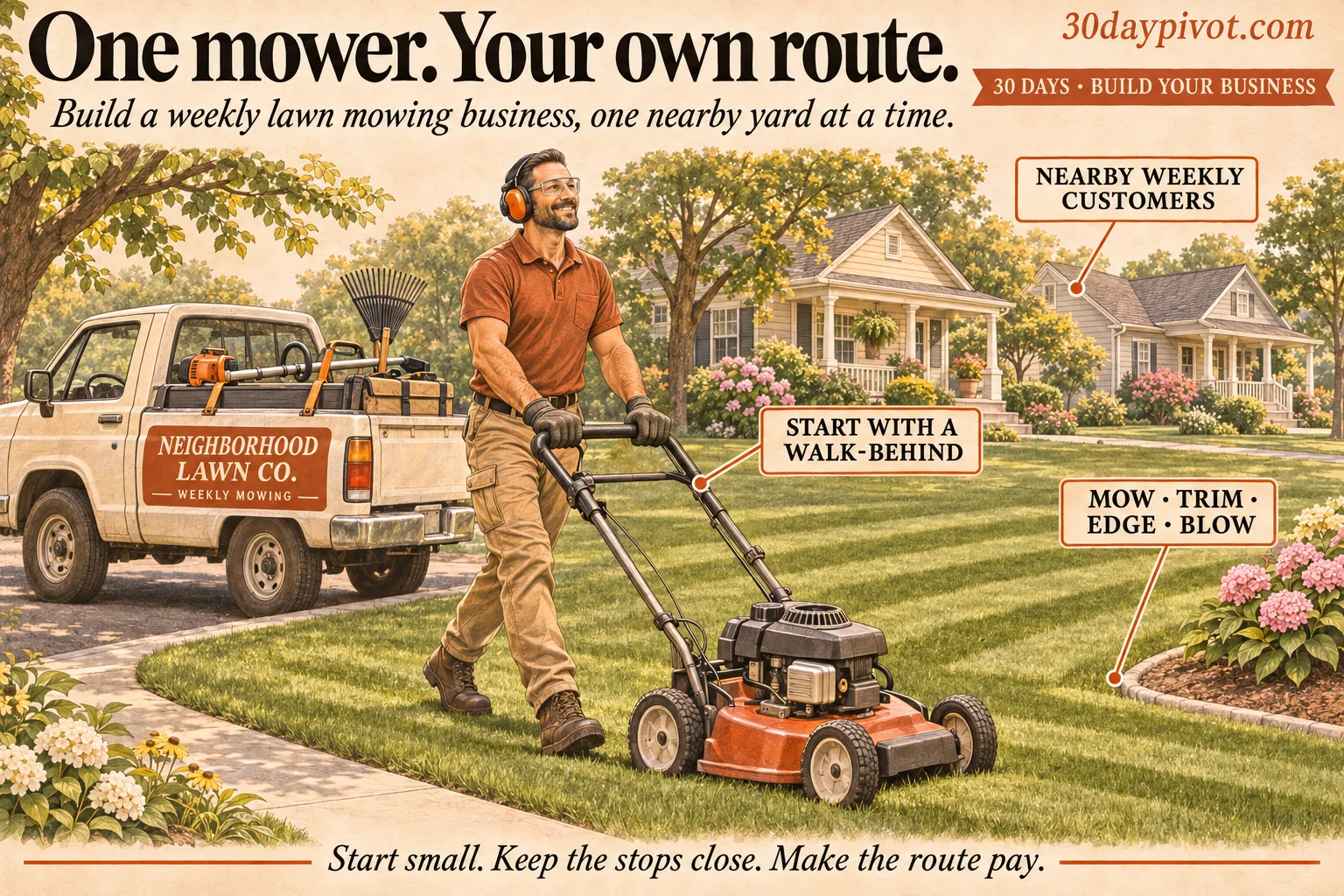
Your first customers live within a mile of your driveway. One used mower, four tasks a visit, the same lawns every week, charged to a card the day you cut. Build a route that fills one day, then four, while the trailer crews are still driving across town for one-off jobs.
$500
To start · used mower kit
$50
Per cut · every week
$40
Kept per cut after fuel, fees, insurance
$5K/mo
Gross run rate · 25-lawn weekly route by month 3
Field manual / 01 · Recurring residential mowing
What these numbers mean. $500 buys a used walk-behind, trimmer, blower and the safety gear; the full bootstrap kit with first-month insurance and a cash reserve runs about $842, and the lean-pro and standard tiers wait until the route earns them. $5K a month is the gross run rate of 25 weekly lawns at $50, where the solo operators in the research land by their third month. It is not take-home pay: the unit math keeps about $40 of every $50 cut before you pay yourself or the IRS. This plan gets you to the first ten paying lawns in 30 days and tells you, in your own numbers, whether the route is worth the next 90.
Weekly mow, trim, edge and blow on small residential lawns. $40 to $65 a visit depending on the yard, charged to the customer’s card after each cut. No chemicals, no mulch, no tree work, no acreage. The money is in showing up on the same weekday every week on the same few streets, so you spend the day cutting instead of driving. Small yards on tight streets are the target: ten of them fit in one afternoon.
Thirty days from now you want ten lawns on the same few streets, paid by card after every cut, and a clean record of what each stop earns you. The research says that’s a hard month, not an impossible one: the operators in the research report five to ten accounts in the first month and eight to fifteen by Day 30 in season. Some weeks you’ll do everything right and hear nothing back. That’s why the plan counts paid cuts, not promises, and why the first week is about getting legal, insured and quoting before you spend a dollar you don’t have to.
Every number on this page carries a small tag saying where it came from: a government or university source, a vendor’s own price list, one operator’s story, or a named expert. When it says “model,” it’s our assumption until you replace it with yours.
What Month 1 pays. Three in-season paths: 2, 6 or 10 weekly lawns by Day 30. That’s $150, $600 or $1,000 collected, and about $49, $414 or $737 left after fuel, fees and insurance, before you pay yourself. Month 1 is thin because customers arrive across the month, not on Day 1. The route math shows how the same ten lawns throw off $2,000 a month, about $1,560 after costs, once they’ve all been on the calendar for four weeks, and how 25 of them get you to $5K.
Route economics / keep this page open
What a $50 cut leaves you
One quarter-acre lawn, $50 a week, charged to the card after each cut. Here is where the fifty goes. Fuel, blades and line are small. The card fee is the biggest line until you have enough volume to justify the paid plan. Insurance is $57 a month whether you cut four lawns or forty, which is why the second ten customers are worth more than the first ten. Vehicle cost is figured at the IRS mileage rate as a stand-in for gas, wear and the eventual tire bill.
A paid $50 quarter-acre stop on the ten-customer example route
Item
Per completed visit
Basis: replace assumptions with your log
Service revenue
$50.00
One standard-price weekly cut. Exclude sales tax, gratuity and extras.
Machine fuel
$1.50
Budgeted mower, trimmer and blower fuel combined; measure refill gallons per completed visit.
String / sharpening / blades
$1.00
Consumables allowance. Save actual receipts.
Machine wear / repair reserve
$2.50
Equipment replacement and non-consumable repairs. Not a second cash purchase.
Vehicle use
$2.28
3 business miles × $0.76 as a planning proxy, not reimbursement or measured cash fuel.
Card fee
$2.25
Free plan: $50 × 3.9% + $0.30 for one completed visit per charge.
Total variable cost
$9.53
Includes the card fee; $7.28 without a charge.
Contribution before fixed costs
$40.47
$50 − $9.53. This is not take-home pay.
General liability
$1.425
$57/month ÷ 40 paid visits. If there are only four paid cuts, it is $14.25 each.
Software subscription
$0.00
Free plan. Processing already included above.
Modeled operating return per stop
$39.05
$40.47 − $1.425 = $39.045, rounded once. Before owner labor, tax and other actual overhead.
One customer for a month: 4 cuts × $50 = $200. About $38 of that goes to fuel, supplies, wear, mileage and card fees. If that one customer is carrying the whole $57 insurance bill, you keep about $105, or $26 a cut. The first customer is always the most expensive one.
Ten customers on the calendar all month: 40 cuts × $50 = $2,000. Costs run about $381, insurance $57, so you keep roughly $1,560. Forty hours on the route plus eight hours of quoting and admin puts that at about $32 an hour before tax. That is the settled version of the route. The launch month below is thinner because the customers show up across the month, not on Day 1.
Replace every line in that table with your own receipts as soon as you have them. The mileage figure is a stand-in; if you are running a paid-off car, your real cost is lower. Phone, disposal fees, a second policy and the hours you spend quoting all come out of what is left. Taxes come out of it too. Set the tax money aside the day the deposit lands.
Income trajectory: work completed in each period, not cumulative revenue
Source: Planning scenarios, not operator results. Each weekly count is one completed, paid cut per weekly account then active. Revenue = cuts × $50; return = cuts × $40.47 − fixed liability − print. Half-month liability at Day 14, $57 per modeled month; $15 print once in Month 1. Day 14 is already included in Day 30. No repeat print spend or premiums beyond the modeled GL are assumed in Months 2–3. Inputs: Yardbook: credit card fees · Insureon: lawn-care policy medians · IRS: mileage by effective period.
If the first two weeks are quiet
Nobody books in Weeks 1 and 2. Two small lawns come on in Week 3, a third in Week 4, and rain pushes one cut past month-end. Four paid cuts at $40 is $160 collected, about $51 left after costs, insurance and the print run. That is a slow start, not a failed one. The customers you signed in Weeks 3 and 4 pay for the whole of Month 2. Keep walking blocks; do not start buying ads.
How many stops in a day: plan on three to five with the used walk-behind until your stopwatch says otherwise. Four route days plus a rain day is 20 a week. A settled route with six timed stops a day, or a fifth route day, gets to 25, which is where the strong Day-90 case lands. Mature solo operators in the research run 10 to 12 lawns a day on bigger decks. Operator-reportedGarrett Wallace in Athens does seven to nine a day on an established, mostly biweekly route.
Phase 01 / Days 1–7
Foundation
Insured, equipped, timed and priced in one week.
Day01
Pick your first streets
Phase 1 · Foundation
60–90 min
Objective: Choose the neighborhood you’ll build the route in.
Drive or walk the streets within a mile or two of home. You want small, maintained yards close together, gates wide enough for a mower, and room to park. Postage-stamp lots on tight streets are the money. Long driveways and acreage are not.
Check the season calendar below. If the grass is growing, you’re launching. If it’s dormant, you’re pre-selling spring, and maybe quoting leaf cleanups for cash now.
Write down two numbers: the cash you can put in without touching the bills, and the least you’ll work for per hour. Everything later gets measured against those two.
Field guide / timing
Is grass growing on your block?
Mowing calendar: use the window to plan outreach, not to bill
State
Likely selling window
Adjust on site
GA
Apr–Oct on bermuda
Warm-season turf slows after frost. North Georgia fescue can peak again in fall. Local extension
TX
Mar–Oct in the DFW planning case
South Texas may start earlier. Drought and watering limits can end weekly work before frost. Local extension
Irrigation, climate zone and water restrictions matter more than state lines. Quote a growth trigger. Local extension
Source:Official State extension materials linked in each row. Month bands are planning windows, not guaranteed season lengths. Recheck local advisories and actual blade growth.
End-of-day deliverable
A marked map of three to five target streets, your cash ceiling and your hourly floor.
Day02
Get legal and insured in one afternoon
Phase 1 · Foundation
2–3 hrs plus callbacks
Objective: Clear the three things that have to be true before you take money.
Insurance first. Call two brokers, say “solo residential mowing, no chemicals, no employees,” and ask for $1M per occurrence, $2M aggregate general liability. Lawn-care policies run about $57 a month. Ask whether your personal auto policy covers hauling gear for work; if not, price the endorsement. Get the effective date in writing.
Register the name if your state wants it. The table below shows each state’s filing and what it costs. Working under your own name as a sole proprietor is fine to start. An LLC can wait until the route is paying.
One call to your state revenue office: “Is residential mowing taxable here?” Most states say no. Texas, Pennsylvania and Ohio have rules worth knowing. Write the answer down and move on.
Field guide / before the first cut
What you actually need before the first paid cut
Three things: liability insurance, a business name your state recognizes, and a straight answer on sales tax. An LLC is optional and can come later; it is not a license and it is not insurance. The table shows the filing office, the tax rule and the LLC fee for the eight biggest mowing states. Everyone else makes the same three calls: Secretary of State or county clerk, state revenue office, and city hall for any home-business or noise rule.
Eight-state starting checklist: mechanical residential maintenance only
State
Name and local check
Sales-tax gate
Optional LLC filing
GA
County superior-court trade name; check publication and occupation tax.
Pure mowing labor generally not taxed. Check separately sold products. Tax authority
County assumed name for a sole proprietor; check city solicitation rules.
Taxable unless the self-employed individual works alone, with no partners or other providers, and eligible receipts are ≤$5,000 over the latest four calendar quarters. If exceeded, collect from the start of the following quarter. Verify entity eligibility. Tax authority
County register of deeds for assumed name. Separate mowing maintenance from licensed landscape construction.
Stand-alone grass cutting is landscaping under real-property rules; generally no sales tax collected on the service. Pay applicable tax on inputs. Tax authority
State trade/fictitious name if used. Check local zoning and vendor registration.
Under $5,000 in qualifying calendar-year lawn services: no collection. At $5,000 register and collect on future sales. Regular vendor license $50. Tax authority
County fictitious name where applicable; check city business tax, home-use and local blower rules.
Generally no sales tax on pure mowing labor. Ask CDTFA before bundling goods or installation. Routine mowing is not landscape construction. Tax authority
$70 articles; $20 information statement separately Filing office
Source:Official State agencies in each row; SBA: licenses and permits. Local approvals depend on the actual business and service addresses. Confirm the current fee schedule before filing.
Insurance in one call
Platform/VendorInsureon’s lawn-care medians: $57 a month for general liability, $255 a month for commercial auto. You need the first one before you take money. The second depends on your vehicle and what your personal policy says about hauling work gear; ask, and get the answer in writing. A thrown rock through a bay window is the whole reason for the policy. Ask for $1M per occurrence, $2M aggregate, and a certificate you can text to a customer who asks.
Can wait: the LLC, a trailer, a shop, payroll, and any chemical license. Do not spray, fertilize or sell weed-and-feed under a mowing agreement. If you ever add a helper, workers’ comp and payroll come first.
End-of-day deliverable
Insurance bound or quoted with a start date, name filed or confirmed unnecessary, tax answer on paper.
Day03
Buy the kit
Phase 1 · Foundation
2–4 hrs plus pickup
Objective: Get a working rig into your vehicle for about $500 without starving the operating cash.
Used 21–22″ self-propelled walk-behind ($200), used straight-shaft trimmer ($100), used handheld blower ($60), plus gas cans, line, glasses, ear protection and boots (about $150). Marketplace, pawn shops, estate sales. Watch it start cold, check the deck for cracks, make sure the blade brake works.
Solve hauling. A hatchback or SUV works with a cheap ramp and two straps. Gas gear rides in the cargo area, never the cabin. If your car can’t take a mower safely, that is the first problem to solve, not the mower.
Keep $65 or more back for a repair. The tier table below shows what the lean-pro and standard rigs cost when the route earns them. Nobody finances a commercial mower this month.
Field guide / buying order
Three rigs, three budgets
Three complete planning envelopes, including an unspent reserve
Item
Tier 0 · bootstrap
Tier 1 · lean pro
Tier 2 · standard
Mower
Used 21–22″ walk-behind · $200
30″ commercial walk-behind · $3,098
Used 36″ stand-on · $4,900
Trimmer / routine edging
Used straight-shaft · $100
Commercial straight-shaft · $450
Commercial straight-shaft · $450
Blower
Used handheld · $60
Backpack · $350
Backpack · $350
Safety and field supplies
Boots, eye/ear protection, gloves, rake, labeled cans, line · $150
Tier 0 is a used residential walk-behind and whatever used trimmer and blower you can find. It cuts a quarter acre fine; it just takes longer. Tier 1 is a 30-inch commercial walk-behind that roughly halves the mowing time on the same lawn. Tier 2 is a stand-on and a trailer, which is a different business with a different vehicle. Start at Tier 0, and let Day 25 tell you when the route has earned Tier 1.
Not in the table: sales tax, a hitch if you go to Tier 2, any extra auto premium, and whatever your city charges for a home-business permit. Prices move; check the dealer listing before you drive over.
End-of-day deliverable
Mower, trimmer and blower in the vehicle, receipts and serial photos saved, repair money untouched.
Day04
Time yourself on two lawns
Phase 1 · Foundation
2–3 hrs
Objective: Learn what a full stop takes you, start to finish, with a stopwatch running.
Find two yards you can cut for free: yours, a friend’s, a relative’s. Run the whole stop like a paying job: unload, mow, trim, edge, blow, load. Time each piece on its own.
Note what slowed you down: a tight gate, a bad parking spot, running out of line, a second pass on thick grass. Fix one thing between the first lawn and the second.
Write down your minutes per lawn. That number, not a national average, is what your pricing and your daily capacity run on.
End-of-day deliverable
Two timed stops with minutes per task and one fix applied.
Day05
Price three real lawns
Phase 1 · Foundation
90–120 min
Objective: Turn three measured yards into written weekly prices.
Pull three target houses up on the county parcel map or Google Earth and measure the grass, not the lot. Walk by and note the gate, the slope, obstacles and where you’d park.
Put each one in a band: up to ⅛ acre $40, up to ¼ acre $50, up to ½ acre $65. Overgrown or never-edged yards get a one-time reset price on top of the weekly rate.
Check each price against your Day 4 minutes and your hourly floor. If a big lot doesn’t clear the floor, raise the price or skip it. Don’t cut the small-lawn price to win it.
Field guide / quoting
Price the grass you touch, not the parcel on the deed
Weekly mow, trim, established edge and blow: maintained turf, before sales tax
“For maintained weekly turf my starting prices are $40 up to an eighth acre, $50 through a quarter acre and $65 through a half acre. I measured [area] and checked [gate/edge]. Your weekly visit is $[price] plus applicable tax. That covers mow, trim, edge and blow on [day/window]. The first reset is [none / quoted separately]. No hauling or treatments. Shall I send the acceptance and secure card link?”
Over half an acre, price only after a timed walk-through. Price floor = visit costs + allocated fixed costs + desired hourly return × all owner-hours attributable to the stop. If the market will not pay your floor, choose a closer or simpler lawn.
End-of-day deliverable
Three written quotes with size, weekly price, first-cut condition and what’s included.
Day06
Set up card billing
Phase 1 · Foundation
90–120 min
Objective: Get paid automatically after every cut, without chasing anyone.
Open a free Yardbook account (or Square). Build one service, “Weekly mow, trim, edge, blow,” with fields for gate, pets and service day. The comparison table below shows what each stack costs per $50 charge.
Turn on card-on-file. The customer enters their own card through the hosted link; you never see or store the number. Send yourself a test estimate and accept it.
Rehearse the loop: mark the job done, invoice, charge, receipt. Test a rain skip (no cut, no charge) and a declined card (one update link, not repeated retries).
Field guide / scheduling & billing
Free software still charges for cards
Choose the billing stack before quoting the first job
“I approve [service] at [address] on [cadence], $[amount] per completed visit plus applicable tax. You may charge my saved payment method after each completed visit and email a receipt. Weather delays move the date; no cut means no charge. I can cancel future visits by [method/notice]. Additional work requires my written approval.” Keep the agreed version with the job record.
Optional lead source, not our margin model: GreenPal: vendor fees lists no signup or bidding fee, 5% after a successful payment plus standard domestic processing of 2.9% + 30¢. Its $50 example leaves $45.75 before field costs. Follow its customer and payment terms. Do not add this channel’s fee to a privately won neighbor or move marketplace customers off-platform.
End-of-day deliverable
A working estimate-to-receipt flow and the agreement text below saved as your template.
Day07
Set the go date
Phase 1 · Foundation
2–3 hrs
Objective: Confirm everything is in place and book your first route day.
Cut a second practice lawn against the clock. If your minutes dropped from Day 4, you’re ready. If not, you know exactly what to fix.
One-page checklist: insurance effective date, name filing, tax answer, billing live, gear hauled safely, two timed lawns. Anything missing gets a date next to it.
Drive the target streets at the hour you’d work them. Note traffic and parking. Pick the weekday that becomes your route day.
If it’s winter
Do the hauling, the billing rehearsal and the street drive now. Book the timed cuts for green-up. Spend the dormant weeks pre-selling spring: a written quote with a start date is a customer you don’t have to find in April.
End-of-day deliverable
A dated checklist with every line checked, or a date for the one that isn’t.
Milestone
Day 7. Insured, registered where required, kit in the car, two lawns timed. If the policy date or a filing is still pending, keep quoting and walking; the first paid cut waits for the policy, not the other way round.
Phase 02 / Days 8–14
Momentum
Walk one neighborhood. Get the first paying lawns and their neighbors.
Day08
Make one door hanger with one offer
Phase 2 · Momentum
90 min plus printing
Objective: Print something a neighbor can say yes to in ten seconds.
One service, one price band, one route day, one way to say yes. “Weekly mowing on [street]. [Weekday] route. Scan for your price.” Leave off everything else you could do. A list of services reads as “landscaper” and goes in the bin.
Point the QR code at a short form: address, phone, best day. Quotes go out after you’ve seen the yard. Payment setup happens through the card link, never on the form.
Print 300–500. Put a code on the batch so you know which street it came from. Proof one outdoors on your phone before you order. The field guide below has the walking math and the scripts.
Field guide / first ten customers
The door-hanger play
Expert Mike Andes built the Augusta Lawn Care franchise on this. His numbers below come from a funded, multi-crew launch in Dallas–Fort Worth in November 2026; the tactic scales down to one guy and a stack of cards. Source notes.
Pick the street first. Andes gets 100 to 120 hangers on doors per walking hour, up to 150 on tight streets. Long driveways and big lots cut that in half. His crews close best on lawns of 5,000 to 6,000 square feet or less, and the cards flop in high-end neighborhoods: fewer doors per hour and an offer that reads as cheap. Walk the small-lot streets.
One offer, one service, one action. A card listing mowing, gutters, mulch and treatments makes the homeowner decide what it is about before it hits the trash. Sell the weekly mow. QR code to a short form with the price and the route day. Print a short web address under it for anyone who won’t scan.
Hanger front / no discount required
“Weekly lawn mowing on [street or neighborhood]. Get your [weekday] route price. Scan to see your quote and accept a spot.” On the form, confirm mow, trim, edge and blow, actual price, first-cut terms and billing consent. No invented customer names or false urgency.
If someone opens the door
“Hi, I’m [name]. I’m putting together a weekly mowing route on this block. Would a written price for your lawn be useful?” If you already serve the street and have permission, say so. A no ends the conversation. Skip every no-soliciting sign, even when leaving paper; check city rules and do not use mailboxes.
The five-around. After every job you finish, hang the two neighbors and the three houses across the street. Nine-around takes two on each side and five across. They have just watched you work; this is the highest-yield door you will ever knock on. Log street, batch, date, placements, scans, quotes and paying customers. Two blocks that look the same can answer completely differently.
A 400-piece solo test: arithmetic derived from Andes, not a sales forecast
Input
Calculation
What to record
Walking
400 ÷ 120 to 400 ÷ 100 = 3 hr 20 min–4 hr.
Record actual walking time separately from design, quotes and service.
Print
At 100/hour × 4 hours, he allowed roughly $10–$15 for the printed pieces in that example: 2.5–3.75¢ each implied.
Use $15 in the launch model. This is his rough batch allowance, not a small-run printer quote.
Spring franchise history
One customer per 50–100 hangers: 400 ÷ 100 to 400 ÷ 50 = 4–8.
Not four guaranteed signups for a new solo operator.
November hypothesis
One per 300–400: 400 ÷ 400 to 400 ÷ 300 = 1.00–1.33 expected.
Still in progress, not measured conversion. A single batch can yield zero.
Value your walking time
At his $25/hour labor proxy: $83.33–$100 time + $10–$15 print = $93.33–$115 total.
Add redemption costs and quote time. Divide by actual paying customers, never by scans.
Source:Expert Andes, Augusta Lawn Care, Dallas–Fort Worth field video; attribution and limits. He also floats a weaker one-in-400–500 case later. Small-batch prices can be higher.
First mow free? That is Andes’s hook and it gets attention. It costs you about $7 in fuel and supplies plus an hour. Worth it on a measured, maintained lawn where the weekly price is agreed before you cut. Not worth it on a jungle. Skip it if cash is tight; the five-around works without a discount.
Why hangers and not ads: Andes’s Google and Facebook tests cost him $300 to $440 per customer. A solo operator’s hangers cost printing and shoe leather. His 5,000-piece minimum test is for a funded operation. Yours is 300 to 500 pieces, tracked by street, and you let the paying customers tell you where to walk next.
Operator-reported Two other data points. Andrew Huber of The Lawn Squad says 90% of his customers came from his Google listing and 10% from referrals, which is why Day 12 matters. A forum operator put out 750 hangers a year for two years and got nothing. Count paying customers, not cards placed.
End-of-day deliverable
A printed proof, a working form and a batch log with the street code.
Day09
Walk the first 200
Phase 2 · Momentum
2–3 hrs
Objective: Get half the batch onto doors and count what you placed.
Start at one end of your best street. Hang it on the door handle, never in the mailbox. Skip no-soliciting signs and closed gates. Smile at the doorbell cameras; people watch them.
If someone opens the door: “I’m building a weekly mowing route on this street. Want a written price for your yard?” A no is a no. Move on.
Log placed, skipped, minutes and conversations. Keep the other 200 for a second street so you can compare the two.
A map of placements, time spent, and a next step for every lead.
Day10
Quote the leads
Phase 2 · Momentum
90 min–3 hrs
Objective: Turn interest into firm prices with a day and a way to accept.
Call or text every lead the same day. If the batch is quiet, ask five people you know for one introduction each on your streets. Post once in the neighborhood group if it allows it.
Walk up to three yards. Use the Day 5 bands. Name the route day and the rain backup. Give the price in writing.
Send the acceptance and the card link. A yes is “booked,” not “paid.” Set one follow-up date for every quote still open.
A quote register: address, price, channel, status, service day, follow-up date.
Day11
Cut the first paying lawn
Phase 2 · Momentum
1–3 hrs with travel
Objective: Do one stop so well they book the second.
Confirm the gate, pets and scope before you leave. Walk the yard first; if it isn’t what you quoted, show them and agree the change before you start.
Time every piece again. Edges clean, clippings off the walk, gate latched, photo of the finish. If you break something, say so and call your carrier; don’t hide it.
Charge the card, send the receipt, confirm next week’s slot. Then hang five door hangers: the two neighbors and the three across the street.
A paid receipt, next week on the calendar, five hangers on the block.
Day12
Set up your Google Business Profile
Phase 2 · Momentum
60–90 min plus verification wait
Objective: Get one accurate listing so neighbors who search find you.
Create one service-area profile. Real business name, your cell, a lawn-care category, service area set to your streets, home address hidden. Add photos of your own work.
Read the verification sidebar below. Google may put you on a video call and ask to see you, the gear and the vehicle. Have them ready.
While it’s pending, send leads to your quote form and keep walking. Don’t make a second listing and don’t buy reviews; both can get the profile pulled.
What Google asked Andes to show on the verification call
Expert A live video call. The agent screenshotted the door signage, the office, the van and its plate, the engine starting, and the equipment in the back. The profile name had to match the logo. Source notes.
Platform/Vendor For you: one service-area profile, home address hidden, name matching what you registered. No P.O. box as an office, no second profile for the same area. Be ready to show the mower in the car on video. Google: business representation · Google: verification video.
End-of-day deliverable
One profile submitted under your registered name, with a backup contact channel.
Day13
Work the neighbors
Phase 2 · Momentum
2–3 hrs
Objective: Turn every paying stop into the next one on the same street.
Five-around at every job you’ve done: two neighbors, three across. Nine-around if the street layout allows. These are your highest-yield doors because they’ve already seen you work.
Drop the remaining 200 hangers on the comparison street with its own code. Ask each customer for one introduction on their street.
Follow up once on every open quote. If someone says no, ask whether it was the price, the day or the scope. That answer is worth more than the sale.
A funnel per street: placed → inquiries → quotes → booked → paid → rebooked.
Day14
Count who’s paid and rebooked
Phase 2 · Momentum
60–90 min plus cuts
Objective: Know your real number: customers who paid once and are on the calendar again.
Cut what’s due, charge each one, confirm each next date. Estimates, maybes and free cuts don’t count yet. Biweekly customers get their own column.
For each street: hangers placed, inquiries, paying customers. No inquiries means the offer or the street. Inquiries but no bookings means the price or the scope. Change one thing.
Book next week’s route and the next outreach block. If the grass is dormant, build the spring callback list and say so plainly in your numbers.
Paying-customer count, next week’s route, and this week’s bank total.
Milestone
Day 14. First paying repeat customers. The operators in the research hit this in Week 2 in season; some take until Week 4. At zero, split the problem: no calls is the street or the offer, calls but no yes is the price or the day. Fix one, walk another block. No ad spend.
Phase 03 / Days 15–21
Growth Engine
Turn stops into a route. Reviews after every job. Measure the drive.
Day15
Build the route
Phase 3 · Growth Engine
90 min plus service
Objective: Turn scattered stops into one weekday run.
Pin every customer. Group by street. Ask each to approve a regular weekday and a backup. Biweekly customers go in alternating A and B weeks.
Drive the order once. Note miles, unload time and minutes between stops. A stop three streets over in traffic can cost more than one a mile away on the same road.
Save a route card: order, address, scope, gate note, price, next date. Gate codes stay off anything public. Keep one weekday open for rain.
End-of-day deliverable
A route card with start and finish times and a rain day held open.
Day16
Ask for the review
Phase 3 · Growth Engine
30–45 min plus service
Objective: Make a review request part of every finished job.
Grab the review link from your Google profile and test it logged out. If the profile is still pending, queue the asks instead of sending a dead link.
Text the script below after every completed visit, every customer, same wording. No discounts for reviews, no asking for five stars.
Log sent and answered. Reply to public reviews in a sentence. Handle a complaint privately and fix the job.
Text / after a completed visit
“Hi [first name], I finished the lawn at [street] and latched the gate. If you’d like to share your experience, here’s my review page: [direct review link]. Thank you, [name].” Send after real service, not as a condition of a free cut. Platform/VendorGoogle: asking for reviews.
End-of-day deliverable
A working link and a sent (or queued) request for every job this week.
Day17
Time the second cut
Phase 3 · Growth Engine
1–3 hrs
Objective: See whether the repeat visit pays what the quote assumed.
Back on the same lawns on the agreed day. Cut by growth, not habit. Time the stop the same way you did on Day 11.
Compare to the first cut. Weekly upkeep should be faster than the reset. Find the one thing still eating minutes and fix it.
Net per stop divided by minutes on site is your real hourly. Add quoting and admin time that evening. Two misses on the same lawn means a new price next cycle.
Objective: Move the cuts, keep the customers, charge nobody for a skipped visit.
Check the forecast and the footing. Wet ground means ruts. Don’t cut to protect a schedule.
Send the rain text below before the window opens. Move the existing job to the rain day; don’t create a second one.
Confirm no invoice went out for the skipped date. Track deferred and lost separately so Month 1’s numbers stay honest.
Text / weather delay
“Hi [name], the ground at [street] is too wet to mow without leaving ruts. I’ve moved your [original day] visit to [new day/window], conditions permitting. There’s no charge for today. I’ll confirm by [time] if the ground needs another day. Does the same gate arrangement work?”
End-of-day deliverable
A rescheduled route and a clean billing check for every skipped stop.
Day19
Keep the mower running
Phase 3 · Growth Engine
60–90 min
Objective: Make sure a $20 part never cancels a $300 day.
Log hours. Check blade, belt, air filter, wheels, line and straps. Sharpen or swap the blade; a dull blade shows on the lawn and the customer notices before you do.
Restock: line, fuel, oil, a spare blade, a spare pull cord. File the receipts under supplies.
Find your backup: a rental shop or a friend’s mower you can get inside an hour. Write the number on the route card.
End-of-day deliverable
A maintenance card with the next service due and a real backup contact.
Day20
Pick the next street from results
Phase 3 · Growth Engine
60–90 min plus outreach
Objective: Spend the next walking hour where the last one paid.
Compare the two hanger codes: pieces, hours, cost, calls, quotes, paying customers, and distance from the route.
Both zero? Check the QR code and the phone number first. Ask one neighbor to read the offer back to you. Then change one thing and run a smaller batch.
Repeat what worked: the better street, or more five-arounds. Turn down one-off lawns across town unless the price covers the drive both ways.
The next block, the offer you’re using and the spending cap for the batch.
Day21
Check the route density
Phase 3 · Growth Engine
60–90 min plus the route
Objective: Find out whether the route is a cluster or a scatter.
Run the route. List paid stops, minutes between them and total hours. Mark the same-street pairs.
Audit the review log: requested versus received. Queued doesn’t count as sent.
No adjacent pair yet? Pick your best customer as the anchor, protect that weekday, and nine-around the block.
End-of-day deliverable
A measured route with at least one neighboring pair, or the gap written down and the anchor chosen.
Milestone
Day 21. Review requests going out after every job and two stops on one street in one day. Density is what makes the hourly number work: three lawns on one block beat five across town.
Phase 04 / Days 22–30
Scale & Optimize
Close the books. Find your ceiling. Decide what the route has earned.
Day22
Fix the worst stop
Phase 4 · Scale & Optimize
60–90 min plus service
Objective: Reprice or drop the lawn that’s dragging your hourly.
Rank stops by dollars after costs divided by all minutes, drive included. Find the bottom one and why: a one-time reset, a long drive, a bad gate.
Work out the price that clears your floor. Offer it for the next cycle with notice. Don’t charge a new rate on the old authorization.
If they say no, finish what you agreed, release the slot, and quote a replacement on the same street.
End-of-day deliverable
A new price with a date, or a documented exit and a replacement quote.
Day23
Reconcile a week
Phase 4 · Scale & Optimize
60–90 min
Objective: Match every cut to a charge to a deposit.
Export invoices, charges, fees and payouts. Match each visit by invoice ID: price, fee, payout, deposit date.
List what’s unpaid or still in transit. Sales tax collected, if your state charges it, is not income. Gross goes in once; the bank deposit is not a second sale.
Set aside tax money now. Self-employment tax is real. Ask a tax pro about quarterly estimates and the mileage method.
End-of-day deliverable
A reconciled week, an unpaid list and a tax set-aside.
Day24
Find your daily ceiling
Phase 4 · Scale & Optimize
2–5 hrs, or the actual route
Objective: Know how many stops a day you can actually carry.
Time departure to return, fuel, breaks and transfers included. If the route is short, fill the empty slots with your timed practice numbers and mark them as filled.
Available minutes, minus the drive to the block, minus slack, divided by minutes per stop plus transfer, rounded down. That is the cap on the booking sheet.
Offer the next open slot on an existing street. Keep the rain day open. Don’t buy a wider deck to fix a long drive.
End-of-day deliverable
A daily limit and a weekly booking grid with the open slots visible.
Day25
Make an upgrade earn its price
Phase 4 · Scale & Optimize
60–90 min plus any demo
Objective: Buy faster only if faster sells another stop.
Measure your gates and loading. Demo or rent the bigger mower on one of your own lawns and time it against the one you have.
Upgrade cost, minus what you’d sell the old gear for, plus trailer, insurance and downtime. Count only minutes you can sell to a named waiting customer.
Cost divided by extra weekly contribution is the payback in weeks. Longer than the season or your cash reserve, stay Tier 0. The example below: $2,000 for two more $50 stops a week pays back in about 25 weeks.
An upgrade has to fit both the gate and the books
Illustration: spending $2,000 more to unlock two additional pre-sold $50 visits a week at $40.47 contribution produces $80.94/week before added overhead. $2,000 ÷ $80.94 takes about 25 fully worked weeks. With no additional sales, there is no revenue payback. Replace the assumed delta, season and measured costs with the demo result.
End-of-day deliverable
A one-page buy-or-wait with the gate test and the named extra customer.
Day26
Decide whether a helper would pay
Phase 4 · Scale & Optimize
45–60 min
Objective: Stay solo unless the second person adds sold stops.
Read the stay-small note below. Name the bottleneck: mowing, driving, quoting, or unpaid admin. A helper only fixes one of those.
Fully loaded hour for a helper: wage, payroll tax, workers’ comp, insurance, travel, training, gear. Check your state’s rules on classification before you offer anyone a shift.
The extra stops the helper makes possible on the same days have to cover all of that plus a cushion. If they don’t, write “no hire” and what would change your mind.
Stay small, from a guy who runs a big one
Expert Mike Andes: below roughly $800,000 to $1 million a year, anyone you hire has to cut grass. He has watched owners at $200,000 to $300,000 with one helper take home as much as a $700,000 operation carrying office staff. His DFW techs get $22 an hour base with performance pay off their labor revenue, landing around $25 to $30 an hour on a full route. Your math is loaded payroll against sold hours, not his franchise’s. Source notes.
End-of-day deliverable
A no-hire decision, or a helper calculation with named extra stops.
Day27
Plan the slow month
Phase 4 · Scale & Optimize
60–90 min
Objective: Keep the accounts through dormancy without faking weekly cuts.
Check the calendar for your state. Ask each customer how they want to hear about cadence changes. Move to as-needed by agreement, not by surprise.
Price leaf cleanup as its own job: pile volume, haul-off, drive. Skip chemicals, tree work and anything you haven’t done before.
Project four weeks of deposits at the slower cadence, minus fixed costs. If it’s short, pause expansion, line up other income, and set spring callback dates.
A slow-month cash forecast and a spring reactivation list.
Day28
Close Month 1
Phase 4 · Scale & Optimize
90–120 min
Objective: Know what you collected, what it cost and what’s tied up in gear.
Repeat Day 23 for the whole month: cuts, refunds, tax held, fees, miles, fuel, supplies, insurance, software.
Two views: operating return (with the wear and vehicle allowances) and bank cash (actual purchases and deposits). Don’t count the mower purchase and its wear allowance in the same view.
Starting balance plus deposits minus payments equals ending balance. Chase any gap instead of plugging it. Back it all up.
Field guide / troubleshooting
First-month mistakes and their fixes
Use the symptom to pick the next action
What went wrong
What to do instead
Quotes but no bookings
Review one real declined quote for scope, frequency, price and route day; change one variable before another batch.
Customer says “I thought bagging was included”
State mulch-in-place versus bag-and-haul on the quote. Get permission for a separately priced reset.
A “cheap” distant lawn uses the afternoon
Measure round-trip route impact, not just mow time. Move it to an existing route day, reprice or decline.
You filled five field days before a storm
Hold a weather window and move the existing visit. Bill completed work once.
A free first cut never repeats
Budget its resources and time, require clear eligibility and record a paid repeat separately. Drop the offer if redemptions consume the reserve.
The bank balance looks like profit
Reconcile gross, tax, fee and payout by invoice. Count empty driving and unpaid admin hours.
A helper or bigger deck looks like progress
Measure two comparable cuts and find a signed extra stop before committing cash.
A card declines or the gate is locked
Record the missed service or unpaid invoice. Send a secure update link or new access window; never charge an unagreed penalty.
An empty profile or a dormant street produces no calls
Keep one accurate profile and use referrals. Set green-up callbacks rather than reporting hypothetical weekly sales.
Objective: Turn Month 1’s numbers into a route you can afford to keep.
Weekly accounts, biweekly accounts, net per stop, total hours. How many more weekly cuts at that margin does your income need? Check it against daylight and season.
One test per 30 days: collect the second paid visit from everyone, fill the route day, then open a second neighborhood only if the first holds its hourly. Each test gets a number, a deadline and a cash cap.
Confirm the next service with every active customer. The waitlist goes in its own list, not the revenue.
A dated 30/60/90 plan with account count, hourly floor, spending cap and next dates.
Day30
Decide: continue, adjust or stop
Phase 4 · Scale & Optimize
60–90 min
Objective: Make the call on your own numbers.
Fill in the worksheet below from your Day 28 books, not from the scenario table. Zero cuts means “not measurable,” not a made-up margin.
Continue and add stops; adjust and run one bounded test; or stop and protect the cash. Name the number that decided it and what would change your mind.
Sign and date it. Continuing: confirm next visits and card authorizations. Stopping: notify customers, settle charges, cancel billing, keep the records.
Worksheet / keep a dated copy
Does this route earn another ninety days?
Use one consistent period, preferably the last four weeks. Enter actuals locally; nothing in this worksheet is submitted. It does not save on reload. Copy your completed line into your own books or print it.
Costs: processing, machine fuel, consumables, wear, vehicle, insurance, printing, software and other overhead. Exclude pass-through sales tax from receipts. Do not count debt principal, personal draws or a full equipment purchase again.
Read the decision against your own cash and time limits
Decision
Evidence that would support it
Write the next action
Continue / scale
Recurring paying accounts are returning; measured net per stop is positive and return per total owner-hour meets your floor. There is capacity after weather slack.
Add a named neighbor to an existing day. Equipment still needs its own payback test.
Adjust / hold
Stops contribute but all-in hours miss the floor, accounts are scattered, or demand is dormant. You can fund one bounded test.
Choose one change: price, block or cadence. Set an end date, cash limit and pass threshold.
Stop / pause
No safe insured route, negative contribution, no affordable runway, or a completed retest still misses your floor.
Stop taking bookings. Notify customers and settle obligations. Reopen only on a written trigger.
Source: Our decision rule. Your bank reconciliation, measured route time and household floor are the evidence; these thresholds are not earnings claims.
End-of-day deliverable
A signed decision and a route that runs every week, or a clean exit with no stray charges.
Milestone
Day 30. A decision in writing and a route that runs every week. A route that fills part of one day is still a route; the next 90 days fill the rest.
Evidence ledger / trace the inputs
Sources and retrieval dates
Re-check fees, equipment stock, local rules and insurance terms before committing cash. Published sources disagree because they price different lots, tools, schedules and definitions of net. The working prices in this roadmap are not promises of a local sale.
Mike Andes, Augusta Lawn Care · field videos, Dallas–Fort Worth, November 2026
Expert
2026-11-25
Source: Primary pages are linked in the first column. Retrieval dates refer to this review; changing local listings may differ when opened again.
Practitioner evidence: Mike Andes, founder of the Augusta Lawn Care franchise, Dallas–Fort Worth, November 2026. Two field videos: one on door hangers, off-season customer acquisition and the Google Business Profile verification call; one on hiring, pay and staying small. His spring door-hanger results are franchise history. His November conversion rate was a test still running when he filmed it.
Legal Notice: This roadmap is published for educational and informational purposes only. It is not legal, financial, professional, or trade advice. Income figures, benchmarks, and timelines referenced are drawn from real operator and creator data and publicly available market information — individual results will vary significantly based on effort, experience, market conditions, and factors outside the publisher's control. No earnings are guaranteed. Where this roadmap describes physical work performed on client property, the reader assumes full responsibility for outcomes. Do not perform paid work on client property without completing hands-on professional training, carrying active general liability insurance, and meeting all local licensing requirements. The publisher and 30DayPivot.com accept no liability for any property damage, personal injury, business loss, or financial harm arising from the application of information contained in this roadmap.
More Roadmaps Coming
Get notified when the next one drops.
New 30-day roadmaps go live every few weeks. Drop your email and we'll let you know — no pitch, no sequence, just the update.